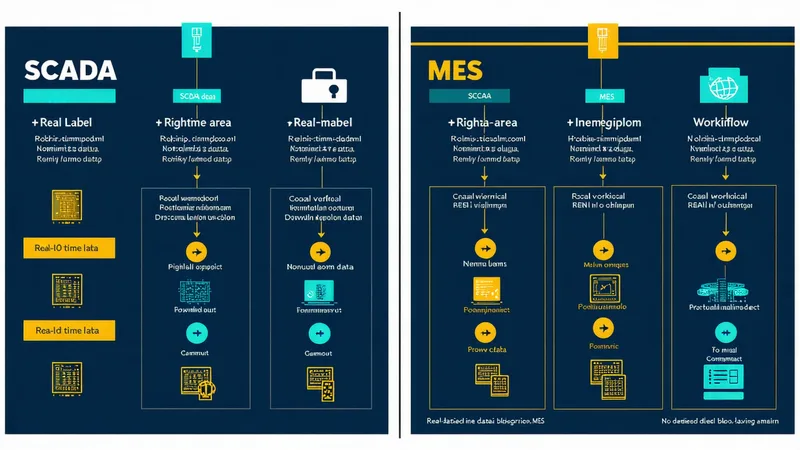
When a production manager starts evaluating factory software, three acronyms appear in quick succession: SCADA, MES, and — more recently — process intelligence. Vendors use these terms inconsistently, and marketing materials frequently apply them interchangeably to products with significantly different capabilities. The result is evaluation processes that stall because the buyer is not sure whether they need an upgrade to their SCADA historian, a full MES deployment, or something in between.
This article defines each layer precisely, describes the gap between them, and offers a practical decision framework for mid-size Japanese manufacturing facilities evaluating which layer to buy first — or first to add to existing infrastructure.
SCADA: Data Acquisition and Process Supervision
SCADA — Supervisory Control and Data Acquisition — is the foundational layer. A SCADA system connects to field devices (PLCs, RTUs, smart sensors) via industrial protocols, collects data in real time, displays it on operator HMI screens, and typically stores it in a process historian. The operator can monitor and, in many configurations, adjust setpoints and issue commands through the SCADA interface.
SCADA systems have been the backbone of process and discrete manufacturing automation since the 1970s. In Japanese manufacturing, common SCADA platforms include Mitsubishi Electric GENESIS64 and MX MESInterface, Yokogawa CENTUM VP and Exaquantum historian, Omron Sysmac Studio with CX-Supervisor, and system integrator-built SCADA layers on top of Wonderware (now AVEVA) or Inductive Automation Ignition.
What SCADA does well: real-time process visibility at the equipment level, alarm management for equipment abnormalities, operator control, and process data storage in a time-series historian. What SCADA does not do: calculate OEE, manage work orders, track lot genealogy, schedule production, or generate performance reports oriented toward production management rather than equipment supervision. These functions are absent by design — SCADA is an equipment-facing system, not a production management system.
The data in a SCADA historian is dense, granular, and often very valuable — but in a form that requires significant processing to become production-management information. A historian storing 1-second PLC scan data for 200 tags over 12 months contains a lot of signal. Extracting OEE, changeover events, and quality deviation patterns from it requires query logic and calculation pipelines that most SCADA systems do not include out of the box.
MES: Production Execution Management
Manufacturing Execution Systems (MES), defined in the ISA-95 standard (also published as IEC 62264), occupy the layer between SCADA and ERP. An MES manages production order execution: dispatching work orders to lines, tracking work-in-process, managing material consumption against lot records, collecting operator sign-offs and quality inspection results, and generating production records for downstream ERP cost accounting and quality systems.
MES systems are comprehensive and, at full deployment, cover 11 functional areas defined in ISA-95 Part 3: production scheduling, production dispatching, production tracking, production data collection, production performance analysis, maintenance management, quality management, document control, resource management, process management, and product definition management. Not all MES products cover all 11 areas fully — the selection and depth of coverage varies significantly by vendor and product tier.
For a mid-size Japanese factory in the 50-200 employee range, a full MES deployment is a 12-24 month project requiring significant IT project management capability, extensive configuration work, and ongoing administration. The cost and complexity are appropriate for facilities where production execution management depth — electronic work instructions, digital quality records linked to every unit produced, real-time WIP visibility for scheduling optimization — justifies the investment. For automotive Tier 1 and Tier 2 suppliers with IATF 16949 requirements and customer-mandated production record formats, this level of system is often necessary.
We are not saying MES is too much for mid-size factories in general. The question is whether the primary pain point — the thing that is costing the most in lost production, quality escapes, or manual effort — is in production execution management (MES's domain) or in production performance visibility and analytics (which does not require MES scope to address).
Process Intelligence: The Analytics Layer
Process intelligence describes a class of systems that connects to existing data sources (SCADA historians, PLCs directly, ERP, manual input), calculates production performance metrics (OEE and its components, scrap rate, cycle time distributions, changeover duration), and provides dashboards, alerts, and traceability records oriented toward production management and continuous improvement.
Process intelligence is explicitly positioned as an overlay layer, not a replacement layer. It assumes you already have PLCs and probably some SCADA infrastructure, and adds the calculation, visualization, and alerting layer that converts raw machine data into production management information. It does not replace the equipment-level supervision function of SCADA, and it does not cover the production execution management breadth of a full MES.
The boundaries of the process intelligence layer vary by product, but a practical minimum scope includes: OEE calculation from PLC data with Availability/Performance/Quality decomposition; downtime event logging with reason code classification; shift and line-level production dashboards; alert routing for threshold breaches; and basic lot traceability linking material inputs to production outputs.
For a facility that has SCADA for equipment supervision and ERP for planning and financial management, process intelligence fills the middle gap: the production management visibility layer that helps production engineers and plant managers make decisions during the shift, not just after the shift report is compiled.
Which Layer Does a Mid-Size Factory Actually Need First?
A practical decision framework starts from the primary pain points, not from a technology selection.
If the primary pain is equipment reliability and operator response time — unplanned downtime is high, operators are not alerted promptly to fault conditions, and the SCADA layer is absent or limited — the starting point is better SCADA and alarm management. Process intelligence built on top of inadequate real-time equipment data will surface OEE numbers that no one trusts because the underlying data has gaps.
If the primary pain is production performance visibility — OEE is calculated from shift reports with a 24-hour lag, line supervisors do not have real-time performance data, and there is no structured way to identify which losses are largest — the starting point is a process intelligence layer. This can typically be deployed in 2-8 weeks on existing SCADA or direct PLC connections, and provides immediate value without MES complexity.
If the primary pain is production execution management — work instructions are paper-based, quality records are manual and disconnected from individual unit traceability, and scheduling is done manually outside the ERP system — the starting point is MES evaluation. This is the right scope for the problem, though the project timeline and cost should be evaluated realistically against the facility's IT capacity.
The sequencing principle that often applies in mid-size Japanese factories: process intelligence first, MES later. Process intelligence can be deployed in weeks on brownfield infrastructure, immediately improves production management visibility, and creates the data foundation that makes an eventual MES project much faster — because the MES implementation team arrives to a facility where the PLC connectivity layer is already working and production data is already being collected and validated.
Where the Boundaries Blur
It is worth being honest about where these definitions break down. Some SCADA platforms — particularly Ignition from Inductive Automation — have module ecosystems that extend into OEE calculation and production reporting that would traditionally be classified as process intelligence or lightweight MES. Some MES products offer lightweight SCADA-equivalent monitoring as part of their platform. Some process intelligence products offer work order management features that approach lightweight MES scope.
The practical question for an evaluation is not "which category does this product fit into" but "which specific capabilities does this facility need in the next 18 months, and which products deliver those capabilities at a cost and deployment complexity consistent with our IT team's capacity?" That question requires a honest assessment of IT resources, which in a 100-person Japanese factory is often one or two people managing ERP, networking, and now considering factory connectivity simultaneously.
The category labels are a starting framework, not a purchasing decision. The genba (現場) conversation — sitting down with the production engineering team and the IT manager and mapping specific pain points to specific software capabilities — is where the evaluation gets real.